
SLU PP 332 vs SLU PP 915: Which ERR Agonist Enhances Aerobic Exercise Capacity?
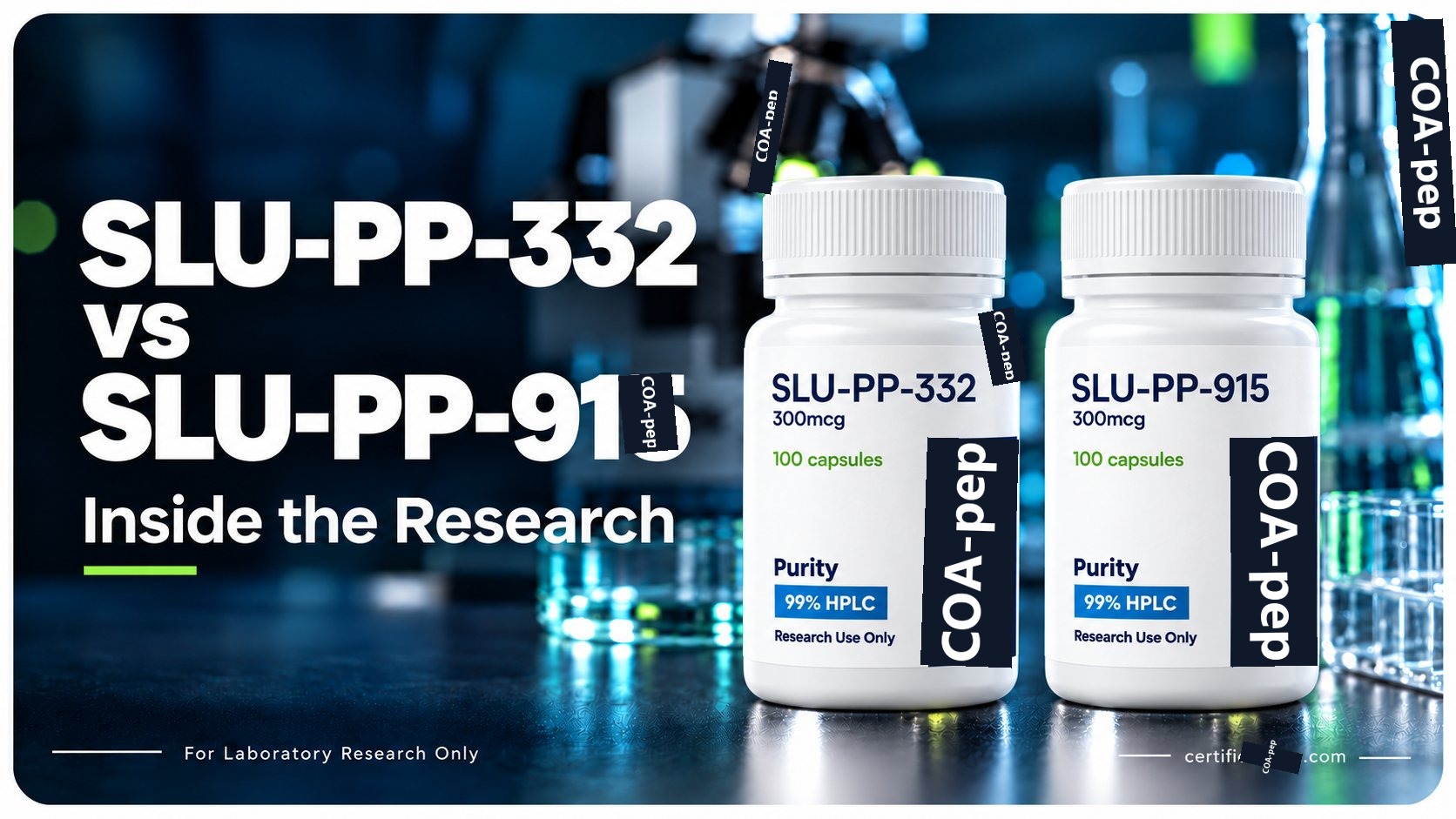
SLU PP 332 vs SLU PP 915 is the comparison researchers started asking about after a 2025 paper showed that the newer compound works by mouth. Both molecules come from the same laboratory at Saint Louis University, and both switch on the estrogen related receptors. The difference is practical. SLU PP 332 needed injection in animal work, while SLU PP 915 was built to survive oral dosing.
This article covers what the published studies measured, where 915 looks stronger, where 332 still leads, and what no study has tested. Both are research chemicals. Neither is an approved drug, and nothing here describes an effect in people.
SLU PP 332 vs SLU PP 915 at a Glance
- SLU PP 915 is the orally bioavailable redesign of SLU PP 332. A 2025 mouse study found it improved aerobic exercise capacity after oral dosing, which 332 could not do.
- When researchers adjusted for exposure, oral 915 matched the exercise-mimetic efficacy of 332. The advantage is exposure, not a stronger effect per unit of drug.
- SLU PP 332 shows higher relative potency at ERR alpha. SLU PP 915 activates ERR alpha, beta and gamma more evenly.
- Both compounds induce Ddit4, a gene tied to the exercise response.
- No human trial exists for either one. Long term safety and human efficacy are unknown.
What Is an ERR Agonist? ERR Activation and the Exercise Mimetic Idea
Estrogen related receptors are transcription factors that sit near the center of how cells use energy. Three estrogen related receptors exist: ERR alpha, ERR beta and ERR gamma. Estrogen related receptor agonism is the shared mechanism behind both compounds in the SLU PP 332 vs SLU PP 915 question. They help set the pace of mitochondrial biogenesis, oxidative phosphorylation and fatty acid oxidation, especially in skeletal muscle and the heart.
An ERR agonist switches these receptors on. Researchers call that ERR activation, and they call the resulting pattern an exercise mimetic effect because it overlaps with the gene program of endurance exercise. SLU PP 332 was described as a synthetic ERR agonist. It was one of the first potent pan ERR agonists, meaning it acts on all three receptors.[1] Chronic therapeutic potential is the long-range goal of this field, though every result so far comes from cells and rodents.
ERR Gamma, Alpha and Beta: Why Isoform Balance Matters
The three receptors are not interchangeable. ERR alpha is abundant in tissues with high energy demand, such as heart and skeletal muscle. ERR gamma is also high in heart and in oxidative muscle fibers. ERR beta is found at lower levels in many tissues. A compound that hits all three can produce a broad response, while one that favors a single isoform may give a narrower one.
This is why the SLU PP 332 vs SLU PP 915 profile difference matters. The 332 data show higher relative potency at ERR alpha. The 2023 paper also found that its acute exercise response depended on ERR alpha. The 915 compound shows a more even spread across ERR alpha, beta and ERR gamma. If a lab wants to study one isoform, the older compound may still fit. If the goal is a wider response after oral dosing, 915 is the better candidate. Researchers are still developing ERR agonists with other balances, and no head to head isoform screen of these two has been published.
Skeletal Muscle Adaptation and Mitochondrial Biogenesis
Endurance exercise triggers skeletal muscle adaptation. Muscle fibers build more mitochondria, raise oxidative phosphorylation capacity and shift toward burning fat. Researchers describe that shift as mitochondrial biogenesis, and it is the outcome the exercise mimetic idea tries to copy without a treadmill.
The 915 paper measured Ddit4 and mitochondrial gene expression in muscle. Ddit4 is a stress-response gene that rises after exercise. Both compounds induced it, and the authors reported that 915 plus exercise training raised expression further. That suggests the compound and real exercise work through overlapping but additive paths, at least at the gene level in mice. It does not show that either compound builds fitness, and no study measured strength or endurance outside the mouse treadmill.
SLU PP 332: What the Mouse Studies Found
The first paper in the series, published in ACS Chemical Biology in 2023, tested SLU PP 332 in mice. It reported that the compound enhances exercise capacity. Mice showed greater running endurance and a higher aerobic performance score. Their acute exercise-like gene response depended on ERR alpha.[1] A follow-up in the Journal of Pharmacology and Experimental Therapeutics (J Pharmacol Exp Ther) tested the compound in diet induced obese mice and in ob/ob mice. The authors reported lower fat mass gain, higher fatty acid oxidation and improved insulin sensitivity.[2]
Those results frame the metabolic benefits researchers care about: metabolic health markers that move in the direction of regular exercise training. They also explain why people searching for fat burning or fat loss find this compound. The studies measured fat mass and energy use in mice. They did not test weight loss in people.
The bioavailability problem
Every in vivo study of 332 used injection. In the original work the compound was given by intraperitoneal injection, which bypasses both the stomach and the liver. A swallowed compound has to survive acid first and liver metabolism second. Without evidence that 332 survives both, oral performance is unknown. That gap explains why dosing in the wider research community has ranged from micrograms to hundreds of milligrams.
An analytical team also reported in vitro metabolism and analytical characterization of both compounds. The 2026 paper in Drug Testing and Analysis (Drug Test Anal) had doping control purposes in mind.[5] In vitro metabolites are the first step in judging how the liver handles a molecule. The design logic of 915 rests on that question.
SLU PP 915: The Orally Bioavailable Redesign
The 2025 paper in the Journal of Pharmacology and Experimental Therapeutics (J Pharmacol Exp Ther), titled “An orally active estrogen receptor-related receptor agonist, SLU-PP-915, enhances aerobic exercise capacity,” is the main source on this compound.[3] The authors reported four findings.
- SLU PP 332 improved aerobic performance in mice but was not orally bioavailable.
- SLU PP 915 is chemically distinct and is orally bioavailable.
- When 915 was injected, the gain in running distance and duration looked similar to 332. When it was given by mouth, efficacy was comparable after adjusting for systemic exposure.
- Both compounds strongly induced Ddit4 in muscle, at levels that matched or beat treadmill running depending on the muscle.
The authors also reported that 915 combined with exercise training raised Ddit4 and mitochondrial gene expression further. They suggested uses in obesity, type 2 diabetes, steatohepatitis, heart failure and age related muscle atrophy.[3] Those are proposals for future work, not results.
What changed in the molecule
SLU PP 332 is an acyl-hydrazide. One way to picture it is a flexible link that can break under harsh conditions. SLU PP 915 swaps that region for a more rigid structure, and chemical descriptions list it as a fluorinated thiophene with a boronic acid group. Commentary on the redesign says the molecule was also reshaped so the liver is less likely to flag it for clearance. The published abstract does not give metabolic stability numbers, so treat that last point as an explanation, not a measured result.
How the Two Compounds Compare
| Feature | SLU PP 332 | SLU PP 915 |
|---|---|---|
| Class | Acyl-hydrazide, synthetic small molecule agonist | Fluorinated thiophene with a boronic acid group |
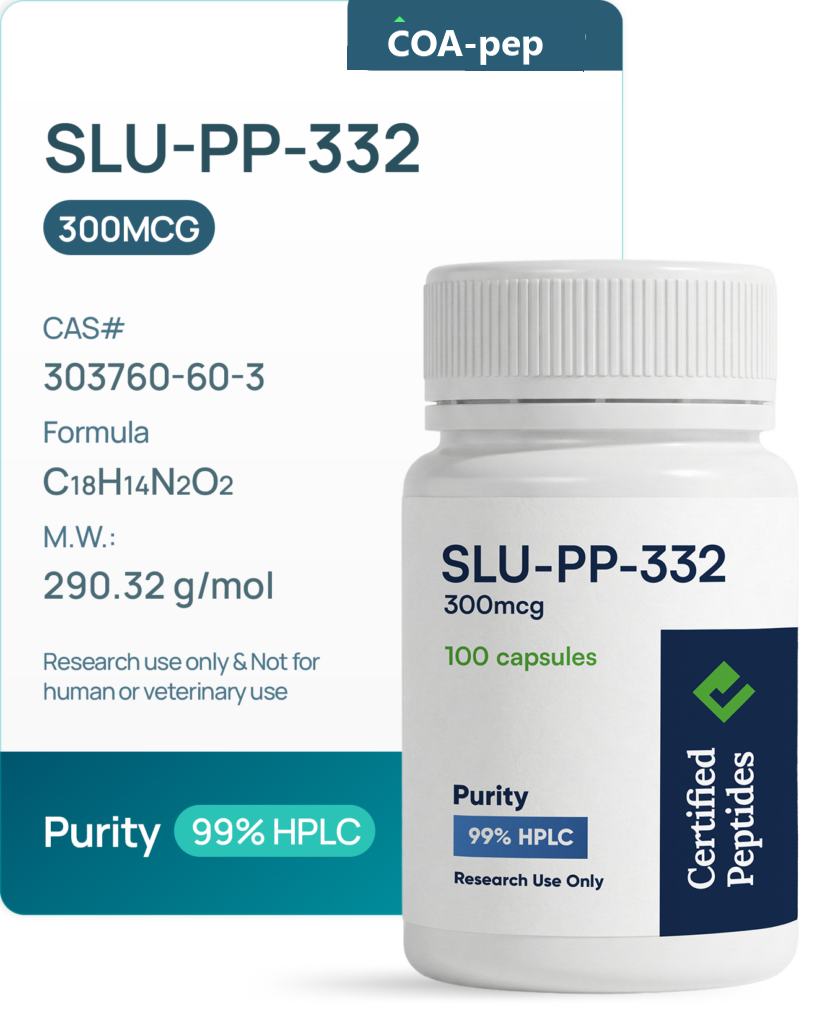
| Reported molecular weight | 290.32 g/mol | 341.16 g/mol |
| Oral bioavailability | Not orally bioavailable | Orally bioavailable in mice |
| Route in animal work | Intraperitoneal injection | Intraperitoneal and oral |
| ERR profile | Higher relative potency at ERR alpha (EC50 near 98 nM on vendor sheets) | More balanced across ERR alpha, beta and gamma |
| Exercise capacity in mice | Improved | Similar when adjusted for exposure |
| Ddit4 induction | Yes | Yes |
| Human data | None | None |
The plain reading of SLU PP 332 vs SLU PP 915 is that 915 is the more practical molecule. It reaches the same targets through a route that fits oral study designs, and it does so with a broader receptor profile. Whether that broader profile is better depends on the question. A study of ERR alpha biology may still prefer 332, since its potency at that receptor is higher.
Heart Failure and Cardiovascular Disease Research
Heart muscle burns fatty acids for most of its fuel, and failing hearts lose that ability. A 2024 Circulation study tested both compounds in a mouse pressure-overload model.[4] The authors reported that the novel pan ERR agonists improved cardiac fatty acid metabolism and mitochondrial function. They linked those changes to better cardiac output. The 2025 paper adds that 915 held up better against liver enzymes and improved cardiac output in mice.[3]
Aging adds another angle. Age related muscle atrophy and an aging kidney both involve falling mitochondrial output, and the authors of the 915 paper named sarcopenia as a target. That is a hypothesis built on animal work. These findings place both compounds in heart failure and cardiovascular disease research, but only at the animal stage. Mitochondrial dysfunction is a feature of many conditions, including an aging kidney and metabolic syndrome, so the same mechanism is being tested well beyond the heart. Physical inactivity is another reason the exercise mimetic idea draws interest, since it covers people who cannot train.
Fat Burning and Fat Loss in Obese Mice
The fat burning angle comes from the 2024 obese mouse work.[2] In diet induced obese mice, 332 reduced fat mass gain and improved insulin sensitivity. The mechanism fits the receptor biology. Higher ERR activity pushes muscle toward fatty acid oxidation and more mitochondria.
No study has compared 332 and 915 head to head on fat loss. In the SLU PP 332 vs SLU PP 915 literature, the metabolic data sit mostly on the 332 side. The 915 paper focused on aerobic exercise capacity and gene expression. Any claim that 915 burns more fat than 332 goes beyond the data.
What the Research Does Not Show
- No human trials. Neither compound has human pharmacokinetic profiles, human efficacy data or long term safety data.
- No head to head metabolic study. The 915 paper compared running performance and gene induction, not fat mass.
- No published bioavailability numbers in the abstract. Exposure was adjusted for, but the abstract does not list the values.
- Nothing about dose. This article gives none because no human dose exists.
The honest summary of SLU PP 332 vs SLU PP 915 is narrow. 915 solved an exposure problem that 332 had, and it appears to keep the same kind of activity. That is a real step for oral study designs. It is not proof of greater effect.
Small Molecules, Not Peptides: Why Testing Still Matters
SLU PP 332 is sometimes sold alongside peptides, but it is a synthetic small molecule, not a chain of amino acids. That changes how a COA is read. There is no sequence to confirm, so identity depends on mass and structure, and purity depends on a clean chromatographic profile. The analytical characterization papers above show that these molecules can be detected and told apart with mass spectrometry. For a buyer, the practical step is to match the batch report to the exact compound and form. Our guide to peptide purity explains the same tests in plain terms.
Research Use and Laboratory Research Purposes
Both compounds are research chemicals. COA-pep sells SLU PP 332 for laboratory research use, and the same standard will apply to 915. They are not for human consumption or for human or veterinary use, and a listing is not a claim about any effect in people. Laboratory research purposes include cell work, animal studies and analytical method development, and each requires its own approvals and controls.
Sourcing SLU PP 332 for Laboratory Research
COA-pep offers SLU PP 332 500mcg tablets for laboratory research use. A listing for SLU PP 915 is planned. Our compounds are Made in China. An ISO/IEC 17025 third-party laboratory tests them for HPLC purity and identity, endotoxins, heavy metals and sterility, and each lot has a batch COA. Read the research purposes only policy before you order.
Research SLU PP 332
SLU PP 332 vs SLU PP 915 FAQ
Is SLU PP 915 more effective than SLU PP 332?
Not on the evidence so far. After adjusting for exposure, oral 915 matched the exercise-mimetic efficacy of 332. Its edge is that it works by mouth in mice.
Why was 332 hard to study orally?
Studies used injection. A swallowed compound must pass stomach acid and liver metabolism, and 332 was not orally bioavailable.
Do both compounds activate the same receptors?
Both act on ERR alpha, beta and gamma. 332 is more potent at ERR alpha, and 915 is more balanced.
Are either approved for people?
No. Neither is an approved drug, and neither has human trial data.
Where can I see testing on research-grade SLU PP 332?
Batch reports are in the COA library, and the lab testing page lists the panel. More answers are in the peptide FAQ.
References
- Billon C et al. “Synthetic ERRα/β/γ Agonist Induces an ERRα-Dependent Acute Aerobic Exercise Response and Enhances Exercise Capacity.” ACS Chem Biol. 2023;18(4):756-771. PubMed
- Billon C et al. “A Synthetic ERR Agonist Alleviates Metabolic Syndrome.” J Pharmacol Exp Ther. 2024;388(2):232-240. Abstract
- Billon C, Appourchaux K, Cote I, Burris TP. “An orally active estrogen receptor-related receptor agonist, SLU-PP-915, enhances aerobic exercise capacity.” J Pharmacol Exp Ther. 2025;393(1):103787. Abstract
- Xu W et al. “Novel pan-ERR agonists ameliorate heart failure through enhancing cardiac fatty acid metabolism and mitochondrial function.” Circulation. 2024;149(3):227-250. PubMed
- “In Vitro Metabolism and Analytical Characterization of SLU-PP-332 and SLU-PP-915: Novel Pan-ERR Agonists With Doping Potential.” Drug Test Anal. 2026. PubMed Central
Research use only
COA-pep products are sold for laboratory research use only. They are research chemicals, not drugs, foods, cosmetics or dietary supplements, and they are not for human consumption or for human or veterinary use. Nothing in this article describes effects in people or offers guidance for use in people.
 English
 French
 Spanish