
Tesamorelin Benefits: What Clinical Research Shows About Visceral Fat and Body Composition
Tesamorelin benefits are well documented in one narrow setting. They are thin everywhere else. The best trials enrolled adults with HIV and excess abdominal fat. They measured visceral fat. Few trials looked at muscle, sleep or general weight loss.
This article covers what those studies measured, what the label warns about, and where the evidence ends. It is written for laboratory research only. Tesamorelin is a prescription peptide in its approved form. The research-grade material sold by COA-pep is not for human use. Nothing below is medical advice. For a short definition, see our FAQ on what tesamorelin peptide is.
Tesamorelin Benefits at a Glance
- Tesamorelin is a synthetic analog of growth hormone releasing hormone (GHRH). It stimulates the pituitary gland to release growth hormone and raises IGF-1.
- In two phase 3 trials in adults with HIV, tesamorelin cut visceral fat by about 11% to 15% over 26 weeks, while placebo groups stayed flat or gained.
- A smaller trial found lower liver fat, which links the peptide to nonalcoholic fatty liver disease research.
- The FDA approved it for excess abdominal fat in HIV-associated lipodystrophy. It is not approved for general weight loss or cosmetic fat reduction.
- Side effects include injection site reactions, joint pain and fluid retention. Long-term effects beyond the approved use are not established.
How Does Tesamorelin Work? A Growth Hormone Releasing Hormone Analog
Tesamorelin is a synthetic analog of the growth hormone releasing hormone (GHRH) that the hypothalamus makes. It binds the GHRH receptor on the pituitary. That triggers growth hormone release, and IGF-1 rises in turn.[1] Growth hormone releasing peptides like this one act upstream of the hormone itself.
This differs from injecting growth hormone directly. Tesamorelin stimulates endogenous growth hormone, so the pituitary keeps control of its own growth hormone through feedback. Researchers describe a pulsatile growth hormone release that follows a more physiologic pattern than a steady supply. The peptide has a short half-life of about half an hour. We cover that in our tesamorelin half-life guide.
Growth hormone signaling then acts on fat tissue. It drives lipolysis, the breakdown of stored fat. The fat metabolism changes are strongest in deep abdominal fat. For that reason researchers describe tesamorelin as a compound that targets visceral fat, not a general fat burner.
Belly Fat and Visceral Fat: The Best-Documented Tesamorelin Benefit
Visceral adipose tissue (VAT) is the deep abdominal fat packed around internal organs. Many people call it belly fat, but it is not the soft fat under the skin. That layer is subcutaneous fat. Visceral fat tracks with insulin resistance and metabolic disease. Excess visceral fat is the target of nearly all tesamorelin research. Visceral fat accumulation is common in HIV-associated lipodystrophy, which is why trials began there.
| Trial | Population | Length | Visceral fat result |
|---|---|---|---|
| Falutz 2007, NEJM | 412 adults with HIV and abdominal fat | 26 weeks | About 15% lower with tesamorelin, about 5% higher with placebo |
| Falutz 2010, JAIDS | 404 adults with HIV, with extension | 26 weeks, then 52 | About 11% lower at 26 weeks, with fat regained after stopping |
| Stanley 2014, JAMA | 50 adults with HIV | 6 months | Lower visceral fat and lower liver fat versus placebo |
In the first phase 3 trial, visceral fat fell about 15% on tesamorelin. On placebo it rose about 5%.[2] That is a significant reduction against a rising baseline. The second trial reported an 11% drop at 26 weeks. People who stayed on treatment for a year saw a larger change.[3] People switched to placebo regained visceral fat. Increased visceral fat returned once the peptide stopped. Visceral fat reduction lasted only while the peptide was given.
The FDA approved tesamorelin in 2010 for excess abdominal fat in HIV patients. The label states that it is not indicated for weight loss.[4]
Liver Fat and Metabolic Health
Visceral fat feeds fat into the liver, so researchers tested whether tesamorelin lowers liver fat. In a 50-person trial, tesamorelin cut liver fat by about 2.9 percentage points more than placebo over six months, alongside a drop in visceral fat.[5] That small study is why tesamorelin appears in nonalcoholic fatty liver disease research. It does not show benefit in people without HIV, and larger trials are needed.
Metabolic health markers moved too. The first phase 3 trial reported improved triglycerides and cholesterol ratios, and the peptide did not worsen glucose control on average.[2] Patients show improved metabolic health markers when visceral fat falls, but improved body composition is not the same as a cured metabolic condition.
The glucose picture needs care. Growth hormone can affect insulin sensitivity, and clinical evaluations suggest tesamorelin can alter glucose metabolism. The label advises glucose monitoring, and it reports diabetes-range HbA1c in a small share of treated patients.[4] Blood sugar is one of the first things a clinician tracks.
Body Composition and Fat Loss: What Changed and What Did Not
Body composition means how the body splits between fat, muscle and bone. Improved body composition in these trials meant less trunk fat. Waist circumference fell, while limb fat did not change.[3] Fat loss was local, not broad. The data show a shift in where fat sits, not a large change on the scale. Physical activity and diet were not the variables under test, and trial reports did not treat the peptide as a stand-in for either.
Body weight and body mass index
Total body weight stayed close to baseline. Body mass index barely moved. The label says tesamorelin is not for weight loss.[4] Anyone who reads belly fat loss as weight loss will misread these studies.
Lean Muscle Mass and Muscle Mass: Preserved, Not Built
People often ask whether tesamorelin builds lean muscle. The data do not say that. The trials aimed at visceral fat. Reports describe lean mass as preserved during visceral fat loss, and some describe lean tissue as stable. Preserved is a weaker claim than gained. No trial showed that tesamorelin raises lean muscle mass in a way that changes strength or function.
Protein synthesis is a second area of interest. Growth hormone and IGF-1 support protein synthesis in other settings. Tesamorelin supports cellular recovery in that sense only as a hypothesis. Overall body composition is the right frame, and some labs study how the peptide may support body composition alongside other inputs.
Sleep quality is another claim you will see online. Published tesamorelin trials in HIV did not report sleep quality as a main outcome. Any sleep benefit is untested.
What Does the Label Warn About?
The FDA label lists side effects that appear more often than with placebo.[4]
- Injection site reactions, about 25% on tesamorelin versus 14% on placebo over 26 weeks.
- Joint pain, limb pain and muscle pain, plus leg swelling from fluid retention.
- Carpal tunnel syndrome in some patients.
- Hypersensitivity reactions in about 4% of patients.
- Antibodies to tesamorelin in about half of patients by 26 weeks.
- Raised IGF-1. In one analysis, about 47% of patients had IGF-1 more than two standard deviations above normal, and long-term effects are unknown.
The label lists pregnancy, active malignancy and a disrupted hypothalamic-pituitary axis as contraindications. Active cancer is a standing concern because growth hormone and IGF-1 can stimulate tissue growth. Uncontrolled diabetes calls for extra caution as well. Any clinical use of tesamorelin therapy sits under medical supervision, with lab and glucose monitoring, a full health history and a medical evaluation beforehand. Nothing about that changes for research-grade peptide, which is not made for people.
Why Tesamorelin Benefits Depend on Context
The phrase tesamorelin benefits means different things to different readers. For a clinician, it means less abdominal fat in a defined group. For a lab, it means a measurable change in growth hormone, IGF-1 or fat tissue in a model. For a shopper, it often means a claim about looks or energy. Only the first two have data behind them.
Three rules help when you read any claim:
- Check the population. HIV trial results do not carry over to other groups.
- Check the endpoint. Visceral fat on a scan is not the same as weight, strength or mood.
- Check the time frame. Most trials ran 26 weeks, and the effect faded after treatment stopped.
A short list of facts keeps the picture honest. Tesamorelin raised IGF-1 in treated adults. It lowered visceral fat in two large trials. It raised glucose concerns that call for monitoring. It has no long-term safety record outside its approved use. Those four points cover most of what is known.
Tesamorelin Peptide Therapy Versus Other Releasing Peptides
Tesamorelin peptide therapy is often compared with sermorelin, CJC-1295 and ipamorelin. All of them aim at natural growth hormone release, and all raise growth hormone production through the pituitary. They differ in structure, half-life and evidence. Tesamorelin has the largest set of controlled trials and the only FDA approval among them. The others rest mostly on smaller or older studies. Peptide therapy as a label covers very different levels of proof.
Patients Focused Trials and Clinical Practice
The clinical trials were patients focused. They enrolled adults with HIV and a defined abdominal fat problem, and they used set entry rules and set follow-up. In clinical practice, a physician weighs the risks of IGF-1 elevation and glucose change against fat loss in that same group. Healthy adults were not the studied group. Applying the numbers to them is a leap.
Where Tesamorelin Clinical Research Stops
- Most evidence comes from adults with HIV. Results in other groups are limited or absent.
- The approved purpose is narrow. The compound is a prescription peptide for abdominal fat in HIV-associated lipodystrophy.
- Benefits depend on continued use. Fat returned after stopping in the extension data.
- Long-term effects beyond the approved use are not established.
- Clinical practice relies on a specific formulation and monitoring plan that research material cannot reproduce.
Our comparison posts cover related peptides. See tesamorelin vs sermorelin, tesamorelin vs CJC-1295 and ipamorelin vs tesamorelin. If you wonder how research tesamorelin differs from the branded drug, read is tesamorelin the same as Egrifta.
Sourcing Tesamorelin for Laboratory Research
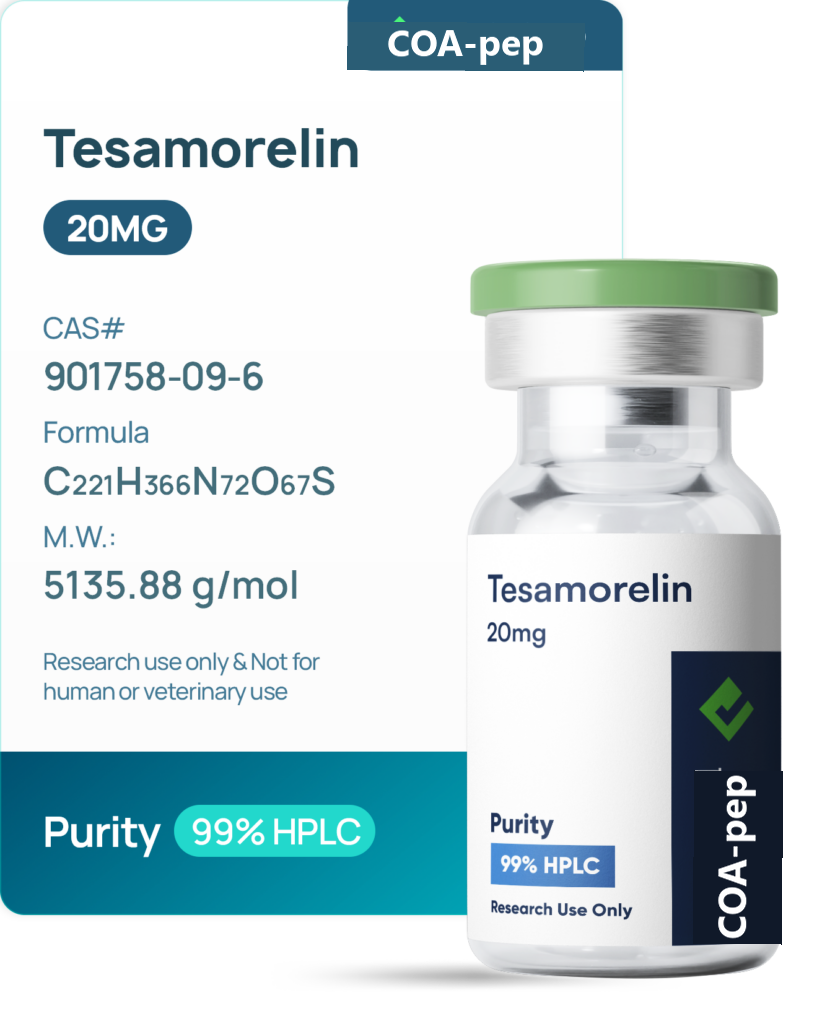
COA-pep offers Tesamorelin 20 mg for laboratory research use. It is Made in China. An ISO/IEC 17025 third-party laboratory tests each batch for HPLC purity and identity, endotoxins, heavy metals and sterility, and every lot ships with a COA. Read the research purposes only policy before you order.
Research Tesamorelin
Tesamorelin Benefits FAQ
Does tesamorelin burn belly fat?
In HIV trials it lowered visceral fat, which is the deep fat around organs. It is not approved for cosmetic fat loss.
Does tesamorelin build muscle?
No trial has shown that. Reports describe lean mass as preserved, which is a different claim.
Is tesamorelin FDA approved?
Yes, for excess abdominal fat in adults with HIV-associated lipodystrophy. The research-grade product is not a drug and is not for human use.
Does tesamorelin raise IGF-1?
Yes. It stimulates growth hormone, and IGF-1 rises with it. The label advises monitoring because the long-term effect of high IGF-1 is unknown.
Why does reducing visceral fat matter?
Visceral fat sits near the liver and other organs. Reducing visceral fat is linked to better triglycerides in these trials. It is a marker, not a proven route to better outcomes.
What are the main side effects?
The label lists injection site reactions, joint pain, fluid retention and headaches. Glucose and IGF-1 need monitoring.
Where can I see testing for research tesamorelin?
Batch reports are in the COA library, and the lab testing page lists the panel. More answers are in the peptide FAQ.
References
- Ferdinandi ES et al. “Non-clinical pharmacology and safety evaluation of TH9507, a human growth hormone-releasing factor analogue.” Basic Clin Pharmacol Toxicol. 2007;100(1):49-58. PubMed
- Falutz J et al. “Metabolic effects of a growth hormone-releasing factor in patients with HIV.” N Engl J Med. 2007;357(23):2359-2370. PubMed
- Falutz J et al. “Effects of tesamorelin, a growth hormone-releasing factor, in HIV-infected patients with abdominal fat accumulation: a randomized placebo-controlled trial with a safety extension.” J Acquir Immune Defic Syndr. 2010;53(3):311-322. PubMed
- EGRIFTA (tesamorelin for injection), U.S. prescribing information. DailyMed
- Stanley TL et al. “Effect of tesamorelin on visceral fat and liver fat in HIV-infected patients with abdominal fat accumulation: a randomized clinical trial.” JAMA. 2014;312(4):380-389. PubMed
Research use only
COA-pep products are sold for laboratory research only. They are not drugs, foods, cosmetics or dietary supplements, and they are not for human or veterinary use. Nothing in this article describes effects in people or offers guidance for use in people.
 English
 French
 Spanish