
Eloralintide vs Cagrilintide: Two Long-Acting Amylin Analogues Compared
The amylin class is having its moment, and two compounds sit at the center of it. Cagrilintide, from Novo Nordisk, is the amylin analogue most researchers already know, thanks to its pairing with semaglutide in CagriSema. Eloralintide is the newer arrival, and it takes a sharper approach: it is a selective amylin receptor agonist built to lean away from the calcitonin receptor that cagrilintide also activates.
We just added the Eloralintide Peptide to the COA-pep lineup, and this comparison is the one researchers ask us about most. Both are once-weekly, fatty acid modified amylin analogues. Both have reached late-stage trials. But the eloralintide vs cagrilintide question comes down to receptor pharmacology, and that difference shapes everything from half-life to the tolerability questions the field is now trying to answer.
Below, we cover how the amylin pathway works, how each compound engages amylin receptors, what the clinical data show, where each one fits next to GLP-1 drugs, and where each stands on FDA approval.
Eloralintide vs Cagrilintide at a Glance
| Eloralintide | Cagrilintide | |
|---|---|---|
| Code name | LY3841136 | AM833 |
| Class | Selective amylin receptor agonist | Non-selective amylin and calcitonin receptor agonist |
| Receptor profile | Favors AMY1, about 12-fold over the calcitonin receptor [1] | Activates amylin and calcitonin receptors [5] |
| Backbone | 37 amino acid peptide with a stabilized bridge between positions 2 and 7 [1] | Acylated amylin analogue [5] |
| Half-life extension | C20 fatty acid chain that binds albumin | Fatty acid chain that binds albumin |
| Reported half-life | 310 to 366 hours (about 13 to 15 days) [1] | 159 to 195 hours (about 7 to 8 days) [6] |
| Schedule in trials | Once weekly | Once weekly |
| Best single-agent result | 20.1% weight loss at 48 weeks (phase 2) [2] | 11.8% at 68 weeks (cagrilintide 2.4 mg, phase 3 arm) [8] |
| GLP-1-class partner studied | Tirzepatide | Semaglutide 2.4 mg (CagriSema) |
| FDA status | Investigational, phase 3 | Not approved; CagriSema under FDA review [11] |
Two things jump out. Eloralintide’s half-life is roughly twice as long, and the two compounds take opposite positions on calcitonin receptor activation. The rest of this post explains why those two facts matter.
The Amylin Class: Why Amylin Analogues Matter
Amylin is a 37 amino acid pancreatic hormone made by pancreatic beta cells. It is released together with insulin after a meal, and it acts as a counterpart to insulin in the meal-time response [4]. Where insulin moves glucose into tissues, amylin acts to slow the arrival of new nutrients. It does three main things:
- Signals satiety. Amylin acts on the area postrema and nearby brain stem regions, which sit outside the full blood brain barrier and can sense hormones in the blood directly [4]. That signal reduces food intake and drives appetite suppression after a meal.
- Slows gastric emptying. Food leaves the stomach more slowly, which smooths the rise in blood glucose and adds to the feeling of fullness.
- Suppresses glucagon after meals. Lower meal-time glucagon means the liver releases less glucose [4].
Native human amylin is a poor research tool and a poor amylin drug. It clears in minutes, and it has a strong tendency to clump into amyloid fibrils, the same aggregates found in the pancreas in type 2 diabetes. Pramlintide solved the aggregation problem with proline substitutions and became the first amylin drug, FDA approved in 2005 as a mealtime injection for diabetes. It still needed frequent dosing before meals.
Eloralintide and cagrilintide are the next step: long acting amylin analogues that last a full week. That jump is why researchers now talk about amylin as its own drug class for weight management and metabolic research, not just a diabetes add-on.
How Amylin Receptors Work
Amylin receptors are unusual. There is no single “amylin receptor gene.” Instead, each amylin receptor starts with the calcitonin receptor and adds a partner protein called a receptor activity modifying protein, or RAMP [4].
| Receptor | Built from | Main natural ligand |
|---|---|---|
| Calcitonin receptor (CTR) | CTR alone | Calcitonin |
| AMY1 | CTR + RAMP1 | Amylin (also CGRP) |
| AMY2 | CTR + RAMP2 | Amylin |
| AMY3 | CTR + RAMP3 | Amylin |
The RAMP partner changes the receptor’s shape and what it responds to. That is why the amylin receptor subtypes and the calcitonin receptor are so closely linked: a compound designed to hit one can easily hit the others.
This creates a real design choice for amylin analogues. A compound can act as a calcitonin receptor agonist as well as an amylin receptor agonist, or it can be tuned to favor amylin receptors. Calcitonin receptor activation has its own effects, and one hypothesis is that it contributes to the nausea seen with some amylin drugs. The amylin and calcitonin receptor balance is the single biggest difference between these two compounds.
Is Eloralintide a Selective Amylin Receptor Agonist?
Yes. Eloralintide is a selective amylin receptor agonist by design, and the cell data back that up. In cAMP assays with human receptors, published in Molecular Metabolism, eloralintide favored the AMY1 receptor [1]:
| Human receptor | EC50 | Relative to AMY1 |
|---|---|---|
| AMY1 | 23.9 pM | Reference |
| AMY3 | 253.8 pM | About 11-fold weaker |
| Calcitonin receptor | 291 pM | About 12-fold weaker |
That is a targeting ratio, not a claim that it works “12 times better.” It means eloralintide activates AMY1 at far lower concentrations than it needs to engage the calcitonin receptor.
Structurally, eloralintide is a 37 amino acid peptide with a C-terminal amide. Native amylin holds its ring shape with a native disulfide bond between positions 2 and 7; eloralintide keeps a stabilized bridge at the same spot. A C20 fatty acid chain on a lysine side chain lets it bind albumin in the blood, which slows clearance. Its molecular weight is about 4,526 g/mol.
The result is a very long exposure window. In a single ascending dose study in 48 healthy volunteers, the terminal half-life was 310 to 366 hours, or about 13 to 15 days [1]. In diet-induced obese rats, eloralintide reduced food intake and lowered body weight by up to 12.3%, mostly from fat mass [1]. The paper calls this a path from discovery to clinical proof of concept.
Read our eloralintide explainer for the full receptor background.
Cagrilintide: A Non-Selective Amylin Receptor Agonist
Cagrilintide acts on both sides of the receptor family. Novo Nordisk designed it as a long acting amylin analogue with agonist activity at amylin receptors and the calcitonin receptor, which is why it is often called a dual amylin and calcitonin receptor agonist [5][6]. Like eloralintide, it carries a fatty acid chain for albumin binding.
The logic behind that design was simple: calcitonin receptor activation also reduces food intake in animals, so activating both might add up. The trade-off is that calcitonin receptor activity may also bring more gastrointestinal effects. Whether that trade-off is real in people has not been settled.
Cagrilintide’s half-life is 159 to 195 hours, about one week, measured in a phase 1b trial that paired it with semaglutide 2.4 mg [6]. That still supports weekly dosing, but drug levels swing more between doses than with eloralintide’s two-week half-life.
Eloralintide and Cagrilintide in Clinical Trials
The clinical data for these two compounds come from separate trials with different lengths, doses and populations. No direct comparison exists. Read the table as the shape of each program, not as a head-to-head result.
| Trial | Compound | Length | Participants | Mean body weight change |
|---|---|---|---|---|
| Phase 1 multiple ascending dose [3] | Eloralintide | 12 weeks | 100 | -2.6% to -11.3% |
| Phase 2 trial [2] | Eloralintide 1 to 9 mg | 48 weeks | 263 | -9.5% to -20.1% (placebo -0.4%) |
| Phase 2 trial [7] | Cagrilintide 0.3 to 4.5 mg | 26 weeks | 706 | -6.0% to -10.8% (placebo -3.0%) |
| Phase 3 REDEFINE 1 [8] | Cagrilintide 2.4 mg alone | 68 weeks | 3,417 (all arms) | -11.8% (placebo -2.3%) |
Eloralintide phase 2
The eloralintide phase 2 study was a 48-week, double blind, placebo controlled trial in adults with obesity, or overweight with a weight-related condition, without type 2 diabetes [2]. Using the efficacy estimand, mean body weight reduction ran from 9.5% at 1 mg to 20.1% at 9 mg, compared with 0.4% with placebo. Results were published in The Lancet in 2025, and five phase 3 trials are now enrolling [13].
Cagrilintide phase 2 and phase 3
Cagrilintide’s own phase 2 trial ran 26 weeks and tested doses from 0.3 to 4.5 mg. Weight loss reached 10.8% at the top dose, versus 3.0% with placebo [7]. In the 68-week REDEFINE 1 phase 3 trial, reported in the New England Journal of Medicine, cagrilintide 2.4 mg alone produced 11.8% weight loss, compared with 16.1% for semaglutide 2.4 mg alone and 2.3% for placebo [8].
What makes these numbers exciting for eloralintide research is the contrast. On its own, eloralintide reached about 20% weight loss in less time than cagrilintide’s best single-agent arm. Different trials, different designs, so no conclusion follows. But it is exactly the kind of signal that makes a selective compound worth studying in the lab.
Eloralintide vs Cagrilintide Next to GLP-1 Drugs
Amylin and GLP-1 act on different brain circuits, which is why both programs pair their amylin analogue with a GLP-1 receptor agonist.
CagriSema. CagriSema is a fixed dose combination of cagrilintide 2.4 mg and semaglutide 2.4 mg given once weekly. In REDEFINE 1, published in the New England Journal of Medicine as coadministered cagrilintide and semaglutide, the combination reached 22.7% weight loss at 68 weeks using the trial product estimand and 20.4% using the treatment policy estimand [8][10]. In REDEFINE 2, in adults with obesity and type 2 diabetes, weight loss was 15.7% versus 3.1% with placebo [9][10]. A cardiovascular trial, REDEFINE 3, is still running to measure clinical outcomes.
Eloralintide with tirzepatide. Eloralintide is being studied with tirzepatide, a dual GIP and GLP-1 drug. In a 48-week phase 2 trial of 367 adults with type 2 diabetes, presented in 2026, the combination reached up to 23.3% weight loss, compared with 14.8% for tirzepatide alone [12]. Pivotal trials of that pairing are expected to start.
| Combined amylin and incretin approach | Status | |
|---|---|---|
| Cagrilintide + semaglutide 2.4 mg | Amylin + GLP-1 | Phase 3 complete; under FDA review |
| Eloralintide + tirzepatide | Amylin + GIP/GLP-1 | Phase 2 complete; phase 3 expected |
For labs, the takeaway is that combined amylin and incretin signaling is where the field is heading. A selective amylin tool makes it easier to separate what the amylin side contributes. The clinical potential of the amylin class may end up depending on exactly that: which receptor, at which ratio, alongside which incretin. Our eloralintide vs GLP-3R comparison looks at how amylin selectivity stacks up against triple incretin agonism.
Gastric Emptying, Appetite and Tolerability
Because amylin acts by slowing gastric emptying and affecting satiety, gastrointestinal adverse events are expected for every amylin drug. Both compounds show them. The question is how much, and whether receptor selectivity changes the picture.
| Data set | Nausea | Other notes |
|---|---|---|
| Eloralintide phase 1, 12 weeks [3] | 8% | Fatigue 11% |
| Eloralintide phase 2, 48 weeks [2] | 11% to 64% across arms (placebo 14%) | Fatigue up to 46%; about 10% stopped due to adverse events [14] |
| CagriSema, REDEFINE 1, 68 weeks [10] | 55.0% (placebo 12.6%) | Any GI event 79.6% (placebo 39.9%); 6% stopped due to adverse events |
A few points matter when reading this table:
- The CagriSema row includes semaglutide, which causes nausea on its own. It is not a clean picture of cagrilintide alone.
- Eloralintide’s nausea was not a straight line with dose. It peaked in the fixed 6 mg arm (64%) and was lower at 9 mg (33%), which points to dose escalation design as a variable worth studying [2].
- Fatigue stands out as a notable effect for eloralintide, especially at higher doses.
Here is where the excitement comes in, and why so many labs are asking about eloralintide right now. Early anecdotal reports from the research community suggest eloralintide comes with much less nausea than cagrilintide. That lines up with the selectivity hypothesis: if calcitonin receptor activity drives part of the nausea, a compound that leans away from it should be easier on the gut. Anecdotes are not clinical data, and no controlled trial has tested it. That makes it an open, testable question for the lab, using matched molar amounts in rodent models with food intake and conditioned taste avoidance as readouts.
Is Cagrilintide FDA Approved? FDA Approval and Regulatory Status
No. Neither compound has FDA approval.
Cagrilintide. Cagrilintide is not FDA approved on its own or in combination. Novo Nordisk filed CagriSema with the FDA in December 2025, and the company has guided to a decision in late 2026 [11]. As of late October 2026, CagriSema was still under FDA review. Approval of the combination would not by itself make cagrilintide alone an approved drug, and no date has been announced for when Novo Nordisk files for cagrilintide as a stand-alone product.
Eloralintide. Eloralintide is an investigational drug in phase 3. Its ENLIGHTEN program includes trials in obesity with and without type 2 diabetes, obstructive sleep apnea, and knee osteoarthritis [13]. No filing has been announced.
Pramlintide remains the only amylin drug FDA approved so far. The regulatory status of both compounds discussed here may change as trials read out, so check primary sources for the latest.
Designing an Eloralintide vs Cagrilintide Study
Because the clinical data come from separate trials, the cleanest comparison happens in the lab. A few design choices make the difference between a useful result and a confusing one.
Match by molar amount. Eloralintide weighs about 4,526 g/mol, and cagrilintide is a similar size. Small differences in mass and salt form still add up, so convert every arm to moles using the lot COA rather than matching milligrams.
Separate receptor activity from whole-animal effects. Cell lines that express the calcitonin receptor with and without each RAMP partner let you measure cAMP signaling at AMY1, AMY2, AMY3 and the calcitonin receptor one at a time [4]. Run both compounds in the same assay, since selectivity ratios shift between cell lines and labs.
Measure the amylin pathway directly. Good readouts in rodents include:
- Food intake over 24 to 72 hours, since both compounds last days
- Gastric emptying, using a marker meal or an absorption test
- Conditioned taste avoidance, to separate fullness from malaise
- Body weight and body composition, to see whether loss comes from fat or lean mass
Plan for the half-life gap. Eloralintide’s longer half-life means it takes longer to reach steady exposure and lingers longer after the last dose. Washout periods and sampling schedules should be set for the longer-lived compound, or the comparison will be skewed.
Run single-compound and vehicle arms. If a GLP-1-class drug is part of the design, include each amylin analogue alone, the GLP-1-class drug alone, the pairings, and a vehicle control. That is the only way to see what each part contributes.
Eloralintide vs Cagrilintide: Which Fits Your Research?
| Research question | Better fit |
|---|---|
| AMY1 receptor signaling with limited calcitonin receptor activity | Eloralintide |
| Whether calcitonin receptor activation adds to food intake effects | Both, side by side |
| Long exposure with steady drug levels in animal models | Eloralintide |
| Recreating the published amylin and GLP-1 combination literature | Cagrilintide |
| Selectivity and gastrointestinal tolerability in rodents | Both, with conditioned taste avoidance readouts |
For most receptor pharmacology work, the selective profile is the more precise tool. It lets a lab study the amylin pathway with fewer confounding signals from the calcitonin receptor.
Where Researchers Get Eloralintide
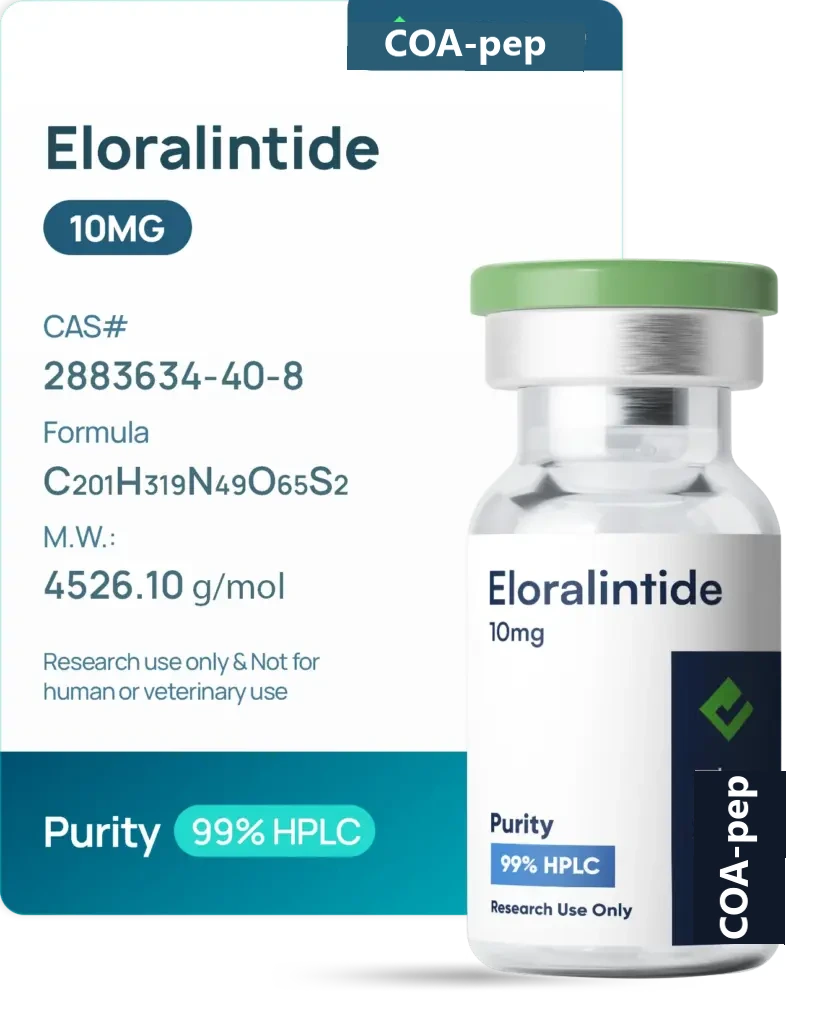
Eloralintide just arrived at COA-pep, and it is the compound in this comparison we are most excited to carry. Our Eloralintide 10mg vial is lyophilized and tested by an ISO/IEC 17025 accredited lab, with a certificate of analysis for each lot in our COA library. It is sold strictly for laboratory research and research use only, and it is not for human consumption.
Add to Research Order
For a shorter answer on how the two compare, see our FAQ: What is the difference between cagrilintide and eloralintide?
Frequently Asked Questions
Is eloralintide better than cagrilintide?
No trial has compared them directly, so no one can say. Eloralintide is more selective for amylin receptors and has a longer half-life, and its single-agent phase 2 results are strong. Those are reasons to study it, not proof that it outperforms cagrilintide.
Do eloralintide and cagrilintide work on GLP-1 receptors?
No. Both act on the amylin pathway, not the GLP-1 receptor. That is why each is studied with a GLP-1-class drug: semaglutide for cagrilintide and tirzepatide for eloralintide.
Why does half-life matter in amylin research?
A longer half-life means more stable exposure between doses. Eloralintide’s half-life of about two weeks is roughly twice cagrilintide’s, which changes how quickly steady levels are reached and how long effects last after the last dose in animal studies.
Do amylin analogues form amyloid fibrils like native amylin?
Native human amylin aggregates readily, which is why it is not used as a drug. Pramlintide, cagrilintide and eloralintide were all engineered to stay soluble, but aggregation is still worth checking in stored solutions. Run a stability check by HPLC if a stock has sat for a while.
Does weight loss with these compounds come from fat or lean mass?
In diet-induced obese rats, eloralintide’s weight reduction came mostly from fat mass [1]. Detailed body composition data in people are still limited for both compounds, and lean mass loss remains an open question for the whole amylin class. Body composition scans in animal studies are the most direct way to answer it.
References
- Briere DA et al. “Eloralintide (LY3841136), a novel amylin receptor agonist for the treatment of obesity: from discovery to clinical proof of concept.” Mol Metab. 2025;102:102271. DOI
- Billings LK et al. “Eloralintide, a selective amylin receptor agonist for the treatment of obesity: a 48-week phase 2 trial.” Lancet. 2025;406(10520):2631-2643. The Lancet
- Bhattachar SN et al. “Eloralintide, a selective, long-acting amylin receptor agonist for treatment of obesity: Phase 1 proof of concept.” Diabetes Obes Metab. 2026. DOI
- Hay DL, Chen S, Lutz TA, Parkes DG, Roth JD. “Amylin: Pharmacology, Physiology, and Clinical Potential.” Pharmacol Rev. 2015;67(3):564-600. PubMed
- Kruse T et al. “Development of Cagrilintide, a Long-Acting Amylin Analogue.” J Med Chem. 2021;64(15):11183-11194. PubMed
- Enebo LB et al. “Safety, tolerability, pharmacokinetics, and pharmacodynamics of concomitant administration of multiple doses of cagrilintide with semaglutide 2.4 mg for weight management: a randomised, controlled, phase 1b trial.” Lancet. 2021;397(10286):1736-1748. PubMed
- Lau DCW et al. “Once-weekly cagrilintide for weight management in people with overweight and obesity: a multicentre, randomised, double-blind, placebo-controlled and active-controlled, dose-finding phase 2 trial.” Lancet. 2021;398(10317):2160-2172. PubMed
- Garvey WT et al. “Coadministered Cagrilintide and Semaglutide in Adults with Overweight or Obesity.” N Engl J Med. 2025. PubMed
- Davies MJ et al. “Cagrilintide-Semaglutide in Adults with Overweight or Obesity and Type 2 Diabetes.” N Engl J Med. 2025. PubMed
- “What Is CagriSema? FDA Status & 2026 Trial Data.” The Rx Index. April 2026. The Rx Index
- “CagriSema: FDA Status, Results, and Uses.” Healthline. October 13, 2026. Healthline
- Pharmaphorum. EASD 2026 report on eloralintide with tirzepatide in type 2 diabetes. October 1, 2026.
- ClinicalTrials.gov. ENLIGHTEN-1 study record, eloralintide (LY3841136). NCT07321886. ClinicalTrials.gov
- “Eloralintide: Trials, Results & FDA Status.” The Rx Index. August 2026. The Rx Index
Research use only
COA-pep products are sold strictly for laboratory research. They are not drugs, foods, cosmetics or dietary supplements, and they are not for human or veterinary use. This article reports published clinical trial results as background on investigational drugs; it does not offer guidance for use in people. Read our research purposes only policy before you order.
 English
 French
 Spanish